
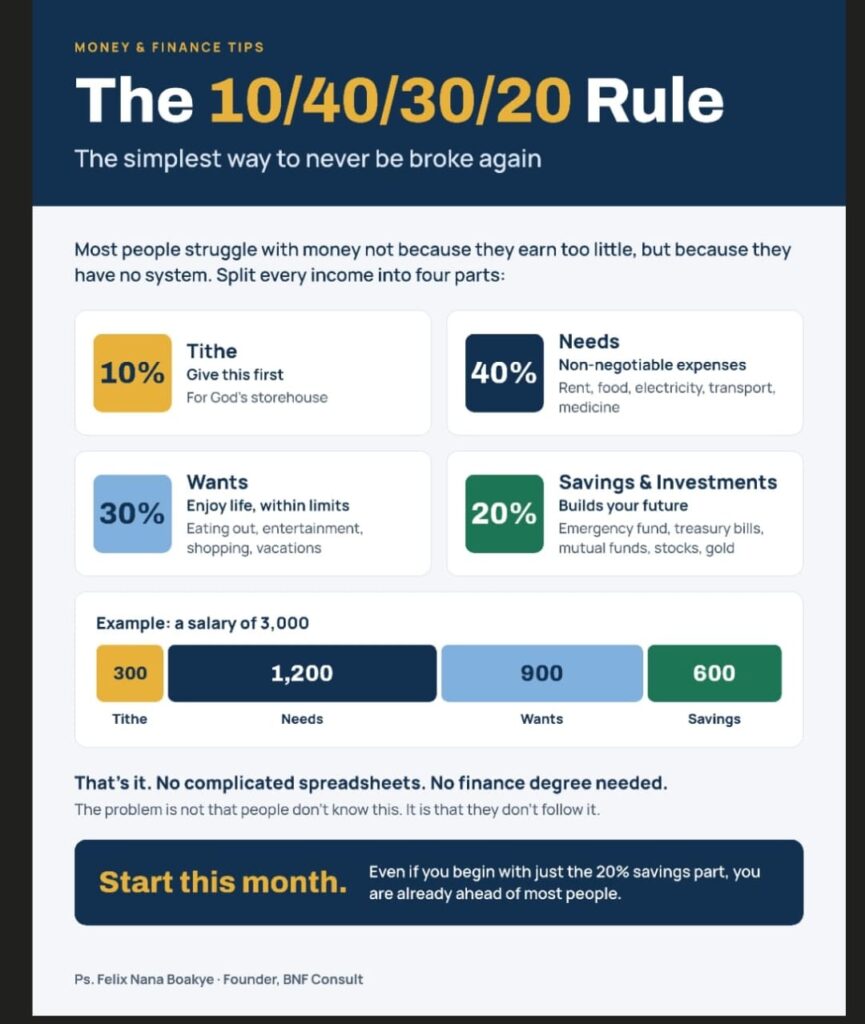
The rule is not about the amount involved. It is about the discipline and commitment to follow it faithfully. Take two people, one earning GH₵3,000 and the other GH₵30,000.
- The rule treats them the same. 10/40/30/20 works in percentages, not amounts.
- On 3,000: tithe 300, needs 1,200, wants 900, savings 600.
- On 30,000: tithe 3,000, needs 12,000, wants 9,000, savings 6,000.
The figures differ, but the structure and the sacrifice are the same.
- The higher amount is often harder to release. The tithe on 30,000 is 3,000, which is the other person’s entire salary. Parting with 300 takes discipline, and parting with 3,000 takes even more. A big income does not make obedience easier.
- Discipline beats income. The 3,000 earner who keeps the rule saves 600 every month, which is 7,200 in a year before any returns. The 30,000 earner with no system lets wants swallow everything and ends the year with nothing. In that case, the one earning ten times less is ahead.
- The rule puts a ceiling on wants. Without it, wants grow as fast as income does. That is why a person can move from 3,000 to 30,000 and still be broke at month end.
- The lower earner is the better proof. If the rule can be kept on 3,000, nobody on 30,000 has an excuse. An example at 30,000 only lets people say, “I will start when I earn more.”
I am doing some research into which income bracket pays tithe most consistently. It is not conclusive yet, but the early picture will surprise you.
We also see it around us. Some people on low incomes have acquired assets to everyone’s surprise, and some of our single mothers raised great men on very little. In every case it was discipline, not the size of the income